Custom hats, shirts, and more – Order online today!

Durable Embroidery for Staff Uniforms: A 2026 Guide
Durable embroidery for staff uniforms: Learn how durable embroidery strengthens staff uniforms. Explore thread types, fabric selection, and maintenance to.
Table of Contents
- Why Durable Embroidery Works Best for Staff Uniforms
- Embroidery vs Screen Printing for Uniforms: Durability Comparison
- Best Thread for Industrial Workwear Embroidery
- Selecting Fabrics That Support Long-Lasting Embroidery
- How to Wash Embroidered Work Shirts for Maximum Longevity
- Customization and Logo Placement for Durable Results
- Troubleshooting Common Embroidery Failures in Workwear
- Sustainable and Eco-Friendly Thread Options for Uniform Programs
Last Updated: August 10, 2026
Why Durable Embroidery Works Best for Staff Uniforms
Durable embroidery for staff uniforms represents the gold standard for professional branding because it combines permanence with polish. Unlike screen printing, which cracks and fades after repeated industrial laundering, embroidery creates a three-dimensional, stitched design woven into the fabric. The needle punctures and thread locks create a bond that washing cycles strengthen rather than degrade.
Your uniform is a walking advertisement. When a logo peels or cracks after three months, your brand looks cheap. A properly executed embroidered logo will outlast the shirt itself because the stitches are woven into the fabric, not sitting on top of it. The decision to use embroidery for staff uniforms is financial: a cracked logo requires a replacement order. An embroidered logo requires nothing but a wash cycle.
Embroidery vs Screen Printing for Uniforms: Durability Comparison
Embroidery and screen printing are fundamentally different technologies. Screen printing applies ink to the surface of fabric; embroidery stitches thread through the weave. That single difference cascades into every durability metric that matters for workwear.
Stitch Density and Thread Tension in Professional Workwear
Stitch density, the number of stitches per inch in an embroidered design, is the primary control lever for durability. Higher stitch density creates more anchor points for thread, resisting pulling, snagging, and unraveling. Professional uniform embroidery typically runs 400-600 stitches per inch, depending on design complexity and fabric weight. Heavy-duty workwear logos often push toward 700 stitches per inch.
Thread tension is equally critical. Too loose, and stitches pull free during washing. Too tight, and the needle punctures weaken the fabric itself. Industrial embroidery machines used by professional uniform manufacturers maintain tension consistency across thousands of stitches. Consumer-grade machines drift. This is why ordering embroidered uniforms from a dedicated uniform manufacturer produces dramatically different durability than ordering from a general apparel shop.
Pro Tip
When requesting embroidered uniforms, ask the vendor for their stitch density specification. If they can’t tell you, that’s a red flag. Reputable embroidery providers know their density targets and adjust them based on design and fabric.
When requesting embroidered uniforms, ask the vendor for their stitch density specification. If they can’t tell you, that’s a red flag. Reputable embroidery providers know their density targets and adjust them based on design and fabric.
Colorfastness and Fade Resistance Over Time
Screen printing ink fades because UV light and washing cycles break down chemical bonds in the ink. Embroidery thread doesn’t fade the same way because it’s fiber, not a surface coating. Polyester embroidery thread is colorfast by design if it’s quality thread from a reputable manufacturer.
Industrial laundering standards, used for restaurant uniforms, healthcare scrubs, and maintenance workwear, include high-temperature water, mechanical agitation, and industrial detergents. After 20+ industrial wash cycles, screen-printed logos show visible cracking and color loss. Embroidered logos show no visible degradation if the thread is quality polyester and stitch density is adequate. After 100 industrial wash cycles, screen printing is barely visible. Embroidery looks nearly identical to day one.
Best Thread for Industrial Workwear Embroidery
Thread selection determines whether embroidery lasts one season or five. The thread sits in direct contact with the garment, absorbs moisture, experiences tension during machine embroidery, and endures repeated abrasion in the wash.
Polyester vs Cotton Thread: What Works for Heavy-Duty Environments
Polyester thread dominates professional uniform embroidery because it handles industrial laundering without degradation. Polyester is hydrophobic and resists moisture absorption, maintaining consistent tension through repeated wash cycles. Cotton thread absorbs water, swells slightly, and creates puckering as it dries and shrinks. In high-traffic workwear, cotton thread is a liability.
Polyester thread also resists heat better than cotton. Industrial wash cycles often include 140-160°F water temperatures. Cotton thread degrades at sustained heat; polyester remains stable. Not all polyester thread is equal. Quality polyester embroidery thread from manufacturers like Gutermann, Robison-Anton, or Isacord is engineered specifically for industrial embroidery machines. These threads have consistent thickness, superior strength, and dyes that bond at the molecular level.
Watch Out
Cotton embroidery thread on workwear uniforms will cause puckering and color fading after 10-15 industrial wash cycles. If a vendor quotes embroidery with cotton thread for commercial uniforms, push back. This is a sign they’re cutting corners.
Cotton embroidery thread on workwear uniforms will cause puckering and color fading after 10-15 industrial wash cycles. If a vendor quotes embroidery with cotton thread for commercial uniforms, push back. This is a sign they’re cutting corners.
Thread Count and Abrasion Resistance
Thread count in embroidery refers to the thickness and ply of the thread. Higher-ply thread (3-ply or 4-ply polyester) is stronger and more resistant to abrasion than single-ply or 2-ply thread. For workwear that experiences friction, logos on sleeves that rub against machinery, chest logos that catch on safety equipment, higher-ply thread reduces the risk of thread breakage and unraveling.
Selecting Fabrics That Support Long-Lasting Embroidery
Embroidery durability depends not only on thread and stitch density but also on the fabric foundation. Weak fabric tears under embroidery stress. Loose weaves allow stitches to pull through. Wrong fabric weight creates puckering and distortion.
Heavy-Duty Fabrics for High-Traffic Environments
Cotton-polyester blends (65/35 or 50/50 cotton-poly) are the industry standard for workwear because they balance durability with comfort. For embroidery specifically, a tightly woven cotton-polyester blend is ideal. Tight weave means the thread has more fibers to grip. Premium workwear uniforms often specify 7-8 ounce fabric weight; heavier fabric can support more aggressive embroidery and withstand more abrasion.
Denim and canvas are popular for work jackets and heavy-duty uniforms because their weight and tight weave support embroidery beautifully. A logo embroidered on 12-ounce denim will outlast the denim itself. Ordering embroidered uniforms on cheap, lightweight fabric is a false economy, the embroidery will look poor, may pucker, and could fail prematurely.
Embroidery Backing and Stabilization Techniques
Backing is the unsung hero of durable embroidery. Most people never see it because it’s sewn to the back of the fabric, but it’s critical to preventing puckering and supporting stitch tension. For lightweight fabrics, tear-away backing is standard. For heavy-duty workwear fabrics, cut-away backing is often necessary. Cut-away backing remains permanently attached to the back of the design and provides ongoing support, preventing the embroidery from shifting or puckering even after repeated washing and wear.
Quality backing tears cleanly and completely, leaving a smooth finish. For uniforms that will be worn frequently and washed repeatedly, investing in premium backing is essential.
How to Wash Embroidered Work Shirts for Maximum Longevity
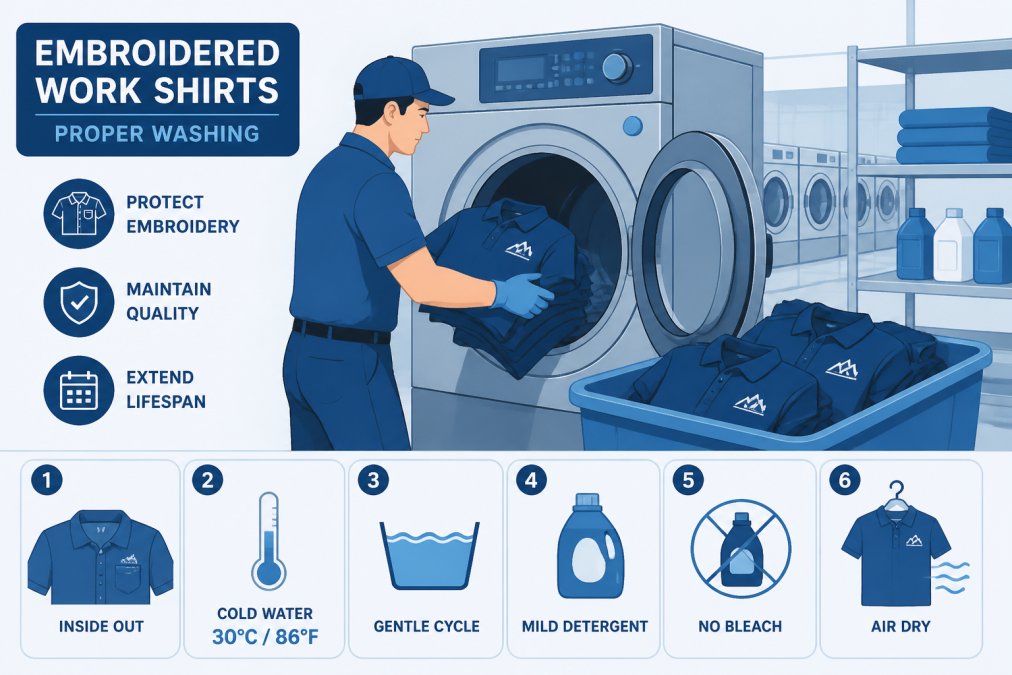
The embroidery’s durability depends partly on how it’s cared for after it arrives. Industrial laundering has specific standards that preserve embroidery integrity, but in-house washing or standard dry cleaning can damage embroidery if done incorrectly.
Industrial Laundering Standards and Wash Cycles
Industrial laundering facilities that handle uniforms follow specific protocols designed to preserve both fabric and embroidery. Water temperature, detergent type, mechanical agitation level, and drying temperature are all calibrated to maximize garment life while removing soils and bacteria.
The standard industrial wash cycle for embroidered workwear uses 140-160°F water, which is hot enough to remove oils and soils but not so hot that it degrades polyester thread. Mechanical agitation is controlled, aggressive enough to clean but not so aggressive that it causes pilling or thread breakage. Drying occurs at controlled temperatures (typically 160-180°F) to prevent shrinkage and preserve thread color.
If your organization handles embroidered uniforms in-house, wash in warm (not hot) water with standard detergent. Use a gentle cycle if possible. Dry on low heat or air dry. High heat and aggressive agitation are the primary causes of embroidery degradation in in-house washing.
Key Takeaway
Industrial laundries preserve embroidery better than in-house washing because they’ve optimized every variable, water temperature, detergent chemistry, agitation, and drying, for garment longevity. For large teams, outsourcing to a professional laundry service will extend embroidery life.
Industrial laundries preserve embroidery better than in-house washing because they’ve optimized every variable, water temperature, detergent chemistry, agitation, and drying, for garment longevity. For large teams, outsourcing to a professional laundry service will extend embroidery life.
Preventing Puckering and Maintaining Textile Integrity
Puckering, the bunching or wrinkling of fabric around embroidery, is usually a sign of improper backing, excessive stitch density, or fabric shrinkage during washing. Once puckering occurs, it’s permanent. Prevention is the only solution.
Puckering happens because embroidery stitches compress the fabric. If backing isn’t adequate or stitch density is too high for the fabric weight, the compressed area shrinks relative to the surrounding fabric, creating visible bunching. The solution starts at production: proper backing selection and stitch density calibration prevent puckering before it starts. After production, gentle washing and low-heat drying prevent fabric shrinkage.
Customization and Logo Placement for Durable Results
Where you place a logo and how you prepare the design file dramatically affect embroidery durability. A poorly positioned logo or a design file that doesn’t translate well to embroidery can fail prematurely even if the thread, fabric, and stitch density are all correct.
Digitization and Vector Files for Precision Embroidery
Digitization is the process of converting a graphic design into machine-readable embroidery instructions. A vector file (like an EPS or AI file) is a mathematical description of the design. The digitizer’s job is to translate the vector file into stitch sequences that an embroidery machine can execute.
A poorly digitized design produces visible problems: thread breakage, distorted shapes, uneven fills, or gaps in the design. A well-digitized design looks crisp, maintains the original design intent, and runs smoothly on the embroidery machine. Professional uniform manufacturers employ skilled digitizers who understand both design and embroidery technology. They adjust stitch density, add underlay stitches to stabilize fills, and optimize stitch paths to minimize thread breakage.
Optimal Logo Placement to Reduce Wear and Stress
Logo placement affects durability because different areas of a garment experience different amounts of stress. A logo on the chest of a work shirt is visible and prominent but experiences moderate stress. A logo on the sleeve cuff experiences high abrasion from repeated arm movement and friction with machinery.
High-stress placement requires higher stitch density and stronger backing to prevent failure. Chest placement is standard for a reason: it’s visible, experiences moderate stress, and allows for adequate stitch density.
Troubleshooting Common Embroidery Failures in Workwear
Even with quality materials and proper execution, embroidery can fail if the design isn’t suited to the execution method or if the garment is mistreated.
Thread Breakage, Puckering, and Digitization Errors
Thread breakage during embroidery production is usually caused by tension issues, poor needle choice, or weak thread. If breakage occurs consistently on the same design, the digitization is likely the problem, stitch sequences that pull thread in ways the machine can’t handle smoothly.
Puckering after production indicates backing or stitch density issues. If puckering appears after washing, the fabric likely shrank unevenly, usually because washing temperature was too high or agitation was too aggressive. Digitization errors produce visible distortions: designs that look fuzzy or distorted, fills that don’t align properly, or outlines that don’t match the original design.
Quality Control for Bulk Uniform Orders
When ordering embroidered uniforms for an entire team, quality control becomes critical. Professional vendors implement quality control checkpoints: they inspect the first garment off the embroidery machine, inspect random samples during production, and perform final inspection before shipping.
For large orders, requesting sample approval before full production is standard practice. You receive a sample garment, inspect the embroidery quality, verify color matching, and approve the design before the vendor produces the entire order. This catches problems early when they’re cheap to fix.
Sustainable and Eco-Friendly Thread Options for Uniform Programs
Sustainability in embroidery is increasingly important for organizations that want to align their uniform program with environmental values. Organic cotton thread is unsuitable for industrial workwear because cotton’s moisture absorption causes puckering in repeated washing. Recycled polyester thread is a more practical option, it has the durability of virgin polyester but uses reclaimed plastic as feedstock and performs identically in embroidery applications.
The most sustainable choice for embroidered uniforms is durability. A uniform that lasts five years requires fewer replacement orders than a uniform that lasts two years, regardless of thread type. Investing in quality embroidery, proper fabric, and correct care extends garment life and reduces the total environmental impact of your uniform program.
Durable embroidery for staff uniforms requires attention to thread quality, fabric selection, stitch density, and proper care. The upfront investment in quality embroidery pays dividends through years of professional appearance and minimal replacement costs. Action Designs specializes in embroidered uniforms that survive the demands of real workwear environments, from industrial laundries to high-traffic manufacturing floors. Our team handles digitization, stitch density optimization, and quality control to ensure every embroidered uniform represents your brand durably and professionally. Get a quote and discover how durable embroidery transforms your uniform program.
Frequently Asked Questions
How durable is embroidered workwear compared to screen printing?
Embroidery creates physical stitches that bond directly to fabric fibers, making it more resistant to cracking and peeling than screen printing. While screen-printed designs can crack after repeated washing and wear, properly executed embroidery with correct stitch density and thread tension maintains its integrity through hundreds of wash cycles. For staff uniforms in high-traffic environments, embroidery typically outlasts screen printing by 2-3 years under normal industrial laundering conditions.
What thread specifications matter most for durable embroidery on work shirts?
Polyester thread is the industry standard for workwear because it resists fading, moisture, and abrasion better than cotton. Look for thread with high thread count and heat-set properties, which improve colorfastness. Thread tension during embroidery is equally critical, too tight causes puckering and fabric damage, while too loose results in loose stitches that snag and unravel. Professional digitization ensures correct tension settings for your specific fabric weight and garment type.
How do I prevent embroidery from puckering on work uniforms?
Puckering occurs when thread tension is too high, backing is inadequate, or fabric isn't properly stabilized during embroidery. Use appropriate embroidery backing matched to your fabric weight, heavier backings for lightweight fabrics, lighter backings for dense weaves. Proper digitization adjusts stitch density and tension for your specific garment. After embroidery, gentle industrial laundering with appropriate wash cycles prevents stress on stitches. Avoid high heat and aggressive agitation in the first wash.
What fabrics work best for durable embroidered staff uniforms?
Heavy-duty fabrics like 100% cotton twill, cotton-polyester blends, and heavyweight canvas provide the best foundation for long-lasting embroidery. These fabrics resist pilling, maintain their shape through repeated washing, and support higher stitch densities without distortion. Avoid lightweight synthetics or thin knits, which can pucker under embroidery tension. For uniforms in high-traffic environments, choose fabrics rated for industrial laundering with colorfastness standards suitable for frequent washing.
This article was written using GrandRanker