Custom hats, shirts, and more – Order online today!

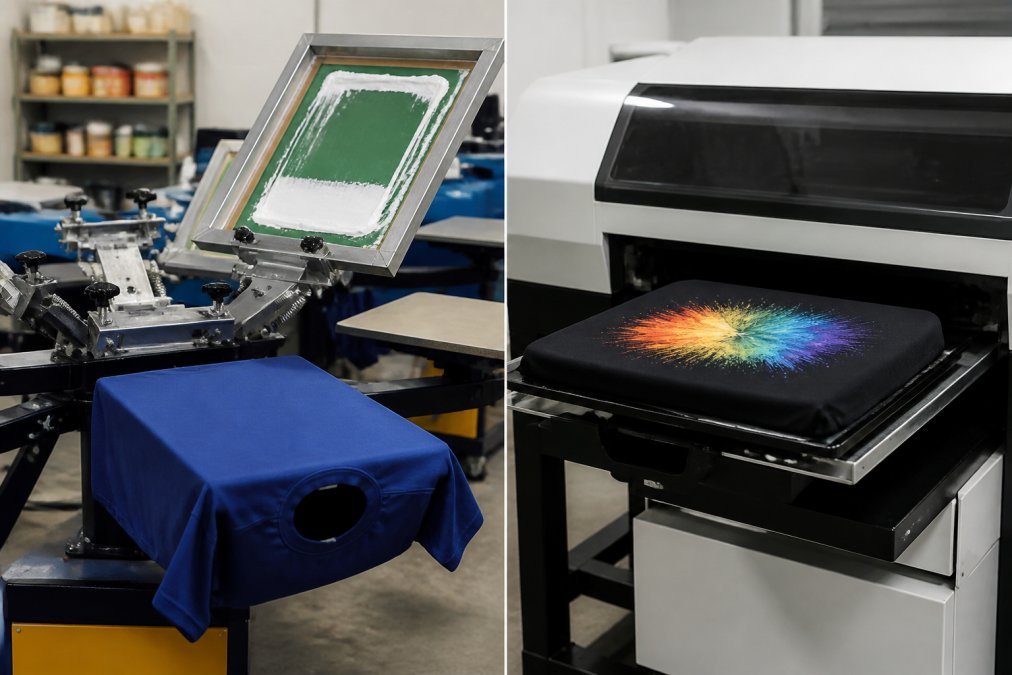
Screen Printing vs DTG for Corporate Uniforms
Screen printing vs dtg: Compare screen printing and DTG for corporate uniforms. Learn durability, costs, and which method works best for your team's.
Table of Contents
- Screen Printing vs DTG: Head-to-Head Comparison
- What Is Screen Printing?
- What Is Direct to Garment (DTG) Printing?
- Durability of Screen Printing vs DTG for Work Uniforms
- Cost Per Unit: Screen Printing vs DTG Pricing Breakdown
- Best Fabric for Corporate Uniforms and Printing Methods
- Which Method Should You Choose for Your Corporate Branding?
- Conclusion
Last Updated: August 9, 2026
Screen Printing vs DTG: Head-to-Head Comparison
When outfitting a team of 50 or 500 people, your printing method affects durability, logo vibrancy, and cost-per-unit. Screen printing excels at durability and cost on large orders; DTG excels at design complexity and small-batch flexibility. The right choice depends on order size, design intricacy, fabric type, and uniform lifespan.
At Action Designs, we empower brands and individuals to bring their unique visions to life through high-quality, durable custom apparel and promotional items. This comparison cuts through marketing noise and shows where each method wins.
What Is Screen Printing?
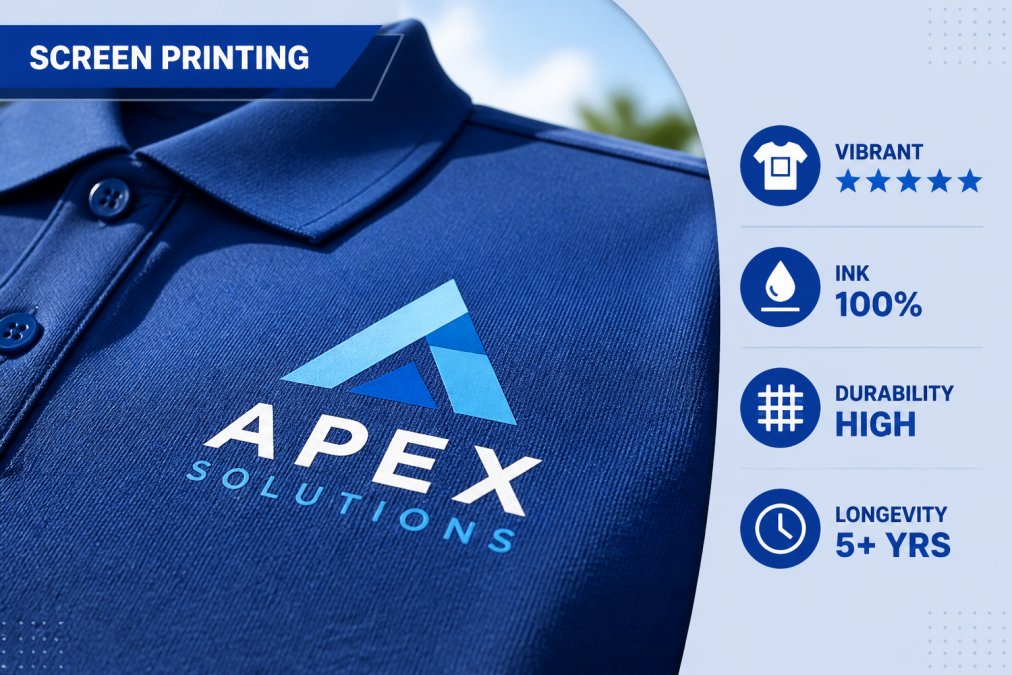
Screen printing is a stencil-based process where ink is pushed through a fine mesh screen onto fabric. A separate screen is created for each color in your design, and ink is pressed through each screen in sequence.
Screen printing dominates corporate uniform production because it’s proven and reliable. When done correctly, screen-printed logos survive hundreds of washes without cracking, fading, or peeling. Your design is separated into color layers; a three-color logo requires three screens. The ink, typically plastisol or water-based, cures through heat and bonds permanently with fabric.
Setup costs are real, creating screens for a five-color design costs money upfront. But per-unit cost drops dramatically as volume increases. A single shirt might cost $12 to print; 500 shirts might average $3.50 each. This is why screen printing dominates bulk orders for corporate uniforms and workwear.
The tradeoff: screen printing struggles with designs containing many colors, photographic elements, or intricate gradients. Each color requires a separate screen, making 10-color designs expensive and time-consuming.
What Is Direct to Garment (DTG) Printing?
Direct-to-garment (DTG) printing is an inkjet-based process where specialized printers spray water-based or pigment-based inks directly onto fabric, similar to desktop printing. No screens. No setup. No color limitations.
DTG printers use garment-specific modifications: wider print heads, precise temperature control, and specialized inks that bond with fabric fibers. The printer reads your digital file and applies color directly in a single pass. This method emerged in the early 2000s and has improved dramatically.
The advantage is speed and flexibility. There’s no screen creation, no setup time, no minimum order quantity. You can print one shirt or 1,000 using the same process. Turnaround is fast, often 24-48 hours.
The limitation is cost-per-unit on large orders. Each shirt requires ink, pre-treatment, and curing time. At 500 units, per-shirt cost is higher than screen printing. At 50 units, DTG is cheaper than paying for screens used once.
DTG performs best on 100% cotton garments. Performance on polyester blends, dark fabrics, or synthetics varies by printer model and ink type.
Durability of Screen Printing vs DTG for Work Uniforms
Screen printing produces prints that survive 50+ industrial wash cycles without noticeable fading or cracking when done correctly. The ink bonds into fabric fibers, creating a permanent bond. Plastisol inks cure through heat and create a plastic-like layer that flexes with fabric.
Durability depends on ink quality, curing temperature, and fabric composition. A properly cured screen print lasts the life of the garment.
DTG printing durability is improving but remains weaker. Water-based DTG inks typically survive 20-40 wash cycles before visible fading. Pigment-based inks perform better, lasting 40-50 cycles. The ink sits on top of fabric rather than bonding into fibers, causing faster fading. High-quality DTG printers with proper pre-treatment and curing can approach screen-printing durability, but don’t consistently match it.
For uniforms worn 3-5 days per week in normal office environments, DTG lasts fine, often 1-2 years before noticeable fading. For industrial workwear or uniforms washed daily, screen printing is the safer choice.
Cost Per Unit: Screen Printing vs DTG Pricing Breakdown
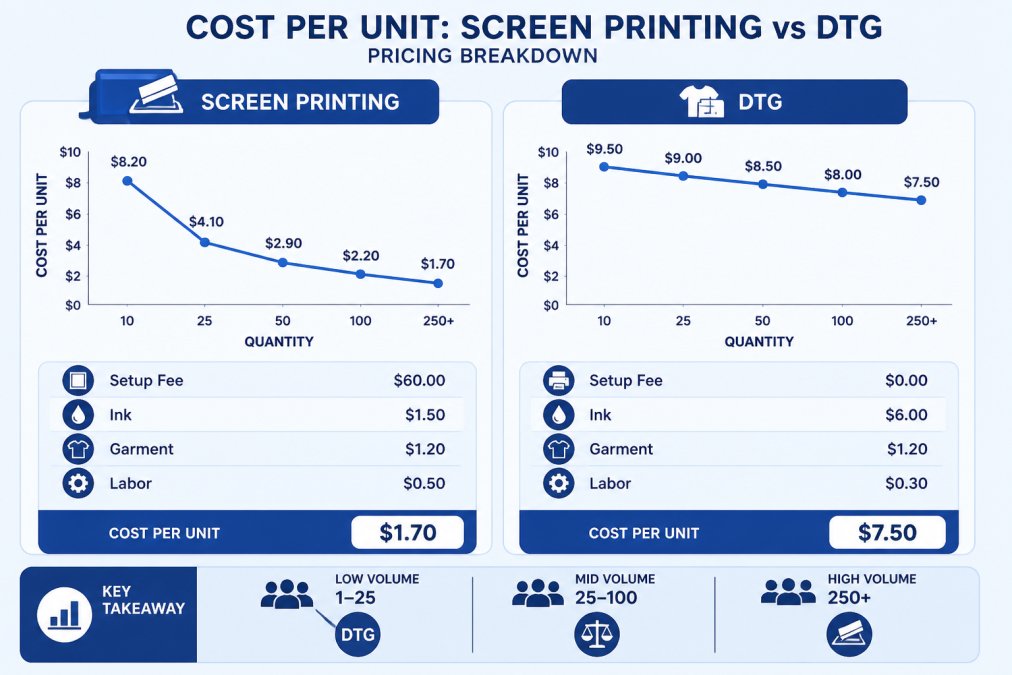
Screen printing costs break into setup and per-unit production. Setup includes screen creation and artwork separation. Per-unit costs drop as volume increases. At 50 units, per-unit cost is higher because setup is spread across fewer garments. At 500 units, per-unit cost is lower.
DTG pricing is simpler: per-unit cost stays relatively consistent regardless of order volume. There’s no setup, so no volume discount. A 50-shirt order costs roughly the same per shirt as a 500-shirt order.
The crossover point, where screen printing becomes cheaper than DTG, typically occurs around 200-300 units, depending on design complexity. Below 200 units, DTG is usually cheaper. Above 300 units, screen printing is usually cheaper.
For corporate uniform programs, this matters. If you’re outfitting 500 people, screen printing saves money. If you’re outfitting 25 people and want flexibility to reorder in smaller batches, DTG might make sense.
Best Fabric for Corporate Uniforms and Printing Methods
Fabric selection directly impacts brand consistency, durability under industrial laundering, and whether your logo maintains color accuracy across multiple production runs.
Screen printing fabric requirements:
Screen printing works best on 100% cotton and cotton-heavy blends (50/50 cotton-polyester is the corporate standard). Cotton fibers accept inks uniformly, ensuring color consistency batch-to-batch. When outfitting 200 employees across multiple locations, the navy polo ordered in January must match the one ordered in June. Cotton-based fabrics deliver this consistency because ink bonds predictably into the fiber structure.
Polyester-dominant blends (65/35 polyester-cotton or higher) complicate screen printing. The ink sits differently on synthetic fibers, causing slight color shifts between batches. For corporate branding where Pantone color matching matters, 100% cotton or 50/50 blends are essential.
Dark fabrics (navy, black, charcoal) work straightforwardly with screen printing. White or light-colored inks screen onto dark fabric with full opacity in a single pass. This matters for safety uniforms or dark-colored corporate dress codes. Print durability on dark cotton is excellent.
DTG fabric requirements:
DTG printing also prefers 100% cotton but works on blends. Modern DTG inks work on 65/35 cotton-polyester blends, though color consistency across batches is less reliable than screen printing. For corporate programs requiring strict color matching, this variability is a problem.
Dark fabrics expose DTG’s biggest limitation. Standard DTG inks are transparent, so they don’t show up on dark garments. To print on navy or black uniforms, you need a white-ink DTG printer, which is more expensive, slower, and limits your color palette. If your corporate uniform includes dark polos with a multi-color logo, white-ink DTG becomes a compromise.
Polyester-heavy blends are problematic for DTG. The ink doesn’t bond reliably, and wash-fastness suffers. If your uniforms need technical fabrics for outdoor teams, DTG performance degrades significantly.
Corporate-specific fabric strategy:
For most corporate uniform programs, the optimal choice is 100% cotton or 50/50 cotton-polyester in light to medium colors (white, light gray, khaki, light blue). This works equally well with both methods, maximizes color consistency, and ensures durability through standard commercial laundering.
If your uniform program includes dark garments, screen printing is the simpler, more cost-effective choice. If you’re mixing garment types, stick with the same fabric base across all pieces to ensure your logo looks identical whether on a polo collar or t-shirt chest.
Commercial laundry services use hotter water and more aggressive chemicals than home washing. 100% cotton with screen printing is the most resilient combination. If uniforms go through industrial laundry, this durability difference becomes significant over a 2-3 year lifecycle.
Which Method Should You Choose for Your Corporate Branding?
The decision isn’t binary. Most organizations choose strategically based on garment type, order volume, and branding requirements.
Choose screen printing if:
- You’re ordering 200+ units of the same design
- Your logo has 5 or fewer colors
- Durability through heavy washing is critical
- You want the lowest per-unit cost at scale
- Your uniforms include dark-colored garments
- You need strict Pantone color matching across multiple production runs
- Your uniform program spans 2+ years
Choose DTG if:
- You’re ordering fewer than 200 units
- Your design includes photographic elements, gradients, or many colors (10+)
- You need fast turnaround (24-48 hours)
- You want flexibility to reorder without large commitments
- Your uniforms are light-colored, 100% cotton garments
- Design complexity or customization (names, numbers) is required
- You’re testing a new uniform design before large-scale production
The hybrid approach:
Most organizations with 100+ employees use both methods strategically. Screen print core uniform pieces in high volume (polos, t-shirts) and use DTG for secondary items, rush orders, or customization. A 300-person company screens 300 polos with the company logo. Six months later, a new department needs 40 polos with a slightly different logo variation. DTG handles the 40-unit reorder without requiring new screens.
This hybrid model optimizes cost while maintaining brand consistency.
Integration with embroidery:
Corporate uniforms often combine printing and embroidery. Screen printing + embroidery: Screen print the main logo on the chest, embroider the company name on the sleeve or back. This is the gold standard for professional corporate wear. Both methods use the same garment base with no compatibility issues.
DTG + embroidery: DTG print a detailed design on the front, embroider a name on the back. This works but requires careful sequencing. The DTG ink must fully cure before embroidery begins, or the embroidery needle can damage the printed area. If your uniform needs substantial embroidery, screen printing is the safer choice for the primary design.
For corporate programs, the typical strategy is: screen print the main branded logo, then add embroidery for personalization. This combination delivers professional appearance and longevity.
Managing multi-location consistency:
If you’re outfitting teams across multiple locations, screen printing is the consistency anchor. When all locations receive uniforms from the same screen-printed production run, logos are identical. DTG introduces variability because each production run is independent. Pre-treatment chemistry, ink saturation, and curing conditions vary slightly between machines and over time.
Strategy for multi-location programs: centralize screen printing for the core uniform. Use DTG or embroidery for location-specific customization. This maintains global brand consistency while allowing local personalization.
Scalability for growing teams:
Screen printing scales efficiently. Once screens are created, adding 100 more units is simple and cheap. Per-unit cost decreases as volume increases. If your company grows from 100 to 200 employees, reordering is straightforward.
DTG scales linearly. Adding 100 more units costs proportionally more because each unit requires ink, pre-treatment, and curing time. However, DTG’s flexibility means you can easily adjust designs as your company evolves.
For long-term corporate programs, screen printing is more scalable economically. For companies with uncertain growth or frequent design changes, DTG’s flexibility is worth the higher per-unit cost.
The practical decision framework:
Start with this question: How many people are you outfitting, and how often will you reorder?
- 50-150 people, one-time order: DTG is likely cheaper and faster.
- 150-500 people, one-time order: Screen printing is likely cheaper per unit.
- Ongoing program (annual reorders): Screen printing for core uniforms, DTG for flexibility and customization.
- Distributed teams (multiple locations): Screen printing for consistency, DTG for location-specific variations.
- Mixed garment types: Screen print the main logo, use embroidery for secondary details, consider DTG for specialty items.
At Action Designs, the key is matching the method to your actual constraints and growth trajectory.
Pro Tip
If you’re uncertain about long-term volume, start with DTG for a smaller pilot order (50-100 units). Test durability, color consistency, and employee feedback. Once you’ve validated the design and fit, switch to screen printing for larger reorders. This hybrid approach minimizes risk while optimizing cost.
If you’re uncertain about long-term volume, start with DTG for a smaller pilot order (50-100 units). Test durability, color consistency, and employee feedback. Once you’ve validated the design and fit, switch to screen printing for larger reorders. This hybrid approach minimizes risk while optimizing cost.
Frequently Asked Questions
What lasts longer on corporate uniforms: screen printing or DTG?
Screen printing typically outlasts DTG on uniforms subjected to frequent industrial laundering and heavy wear. Screen-printed designs resist fading, cracking, and peeling through hundreds of wash cycles because the ink sits on top of the fabric and cures through heat. DTG ink bonds directly with fibers but can fade faster under intense washing and high temperatures. For workwear in manufacturing, hospitality, or field service roles, screen printing delivers superior longevity and maintains color vibrancy longer.
Is screen printing or DTG more cost-effective for bulk corporate uniform orders?
Screen printing offers lower cost per unit for bulk orders of 100+ units because setup costs are spread across larger quantities. DTG has no setup fees, making it cheaper for small orders under 50 units. For a company ordering 200+ uniforms with a simple logo, screen printing typically costs less per shirt. However, if your design includes many colors or photographic elements, DTG may be competitive even in bulk because you avoid multi-screen setup charges. Request quotes for your specific order size and design complexity to compare accurately.
Can DTG handle intricate logos and detailed company branding?
Yes, DTG excels at reproducing intricate designs, fine details, and unlimited colors without setup fees. If your corporate logo has seven colors, gradients, or photographic elements, DTG produces photographic-quality results that screen printing cannot match without creating multiple screens. DTG captures fine detail and color accuracy, making it ideal for complex branding. The trade-off is that DTG costs more per unit on very large orders, so evaluate whether design complexity justifies the higher per-shirt cost for your uniform volume.
What fabric works best for screen printing vs DTG on corporate uniforms?
Screen printing performs well on most fabrics, including cotton, cotton-polyester blends, and synthetics, because the ink sits on the surface. DTG works best on 100% cotton or high-cotton-blend garments (70% cotton or higher) because the ink is absorbed into fibers. For corporate uniforms in polyester or high-synthetic blends, screen printing is the safer choice for consistent results. If your uniform supplier uses cotton-dominant fabrics, both methods work, but confirm fabric composition before finalizing your printing method to avoid color or durability issues.
Ready to bring your corporate branding to life? Action Designs specializes in both screen printing and DTG for corporate uniforms, with the flexibility to scale from 50 shirts to full collections. We handle everything from design consultation to final delivery, ensuring your uniforms maintain brand consistency and durability. Get a quote today and let our team match the right printing method to your specific needs.
This article was written using GrandRanker