Custom hats, shirts, and more – Order online today!

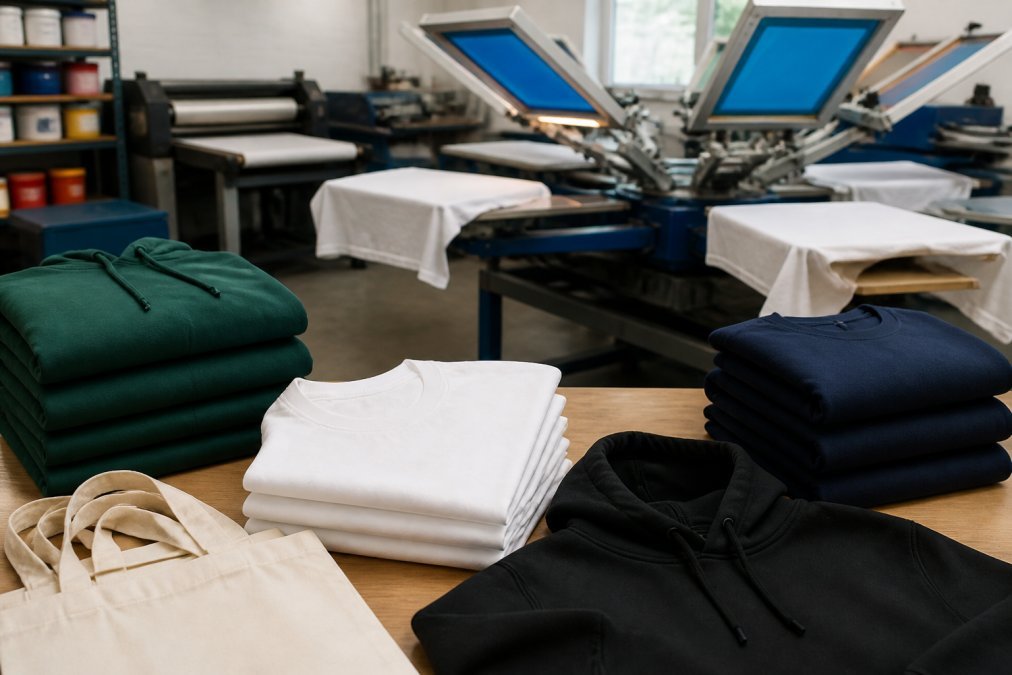
How to Print High Quality Merch: A 2026 Guide
Learn how to print high quality merch with the right file specs, print methods, and fabric choices. Get expert tips and GET A QUOTE today.
Table of Contents
- Why Print Quality Makes or Breaks Your Merch
- Merch Design File Requirements: Resolution, Format, and Color
- DTF vs Screen Printing: Choosing the Right Method
- How Fabric Composition Affects Print High Quality Merch Results
- How to Start a Merch Business: Production and Fulfillment Setup
- Best Print on Demand Companies: What to Look For
- How to Print High Quality Merch: A Step-by-Step Checklist
- Conclusion
Last Updated: August 8, 2026
Why Print Quality Makes or Breaks Your Merch
Print quality is the difference between merch that builds your brand and merch that ends up in a donation bin. A shirt with a cracked, faded logo after three washes signals that your brand cuts corners. Print failures often trace back to decisions made before printing: file quality, method selection, and fabric choice.
This guide covers the complete workflow for printing high-quality merch, from file preparation through fulfillment.
Key Takeaway
Print quality isn’t determined at the press. It’s determined by decisions made three steps before: file format, print method, and substrate selection.
Print quality isn’t determined at the press. It’s determined by decisions made three steps before: file format, print method, and substrate selection.
Merch Design File Requirements: Resolution, Format, and Color
Getting your design file right is the foundation of everything else. Submit a bad file and even the best printer can’t save your output.
Your file needs to be high resolution, in the correct color mode, and sized to actual print dimensions. The standard minimum for print is 300 DPI at actual output size. A logo that looks sharp on a laptop screen at 72 DPI will print blurry and pixelated on a shirt.
Vector vs. Raster: Which File Workflow to Use
Vector graphics are mathematically defined paths that scale infinitely without quality loss. Raster images are pixel grids that degrade when enlarged. For merch printing, this distinction determines whether your design looks crisp or falls apart.
Vector files (.ai, .eps, .svg) are the gold standard for logos, text, and flat-color artwork. They’re resolution-independent and nearly mandatory for screen printing, where each color gets separated into its own layer.
Raster files (.png, .jpg, .tiff, .psd) are appropriate for photographic images, gradients, and complex digital artwork. The critical rule: the file must be sized to actual print dimensions at 300 DPI minimum. A .png exported at 72 DPI from a web project is not print-ready, regardless of how large it appears on screen.
DPI, Bleed, and Color Profiles Explained
DPI (dots per inch) measures print resolution. For garment printing, 300 DPI at actual print size is the baseline requirement.
Bleed refers to artwork extending beyond the intended trim edge, preventing white borders if the substrate shifts during cutting. For cut-and-sew applications, a standard 0.125-inch bleed is common.
Color profiles are where many clients run into trouble. Screens display color in RGB mode, which has a wider gamut than print. Most garment printing outputs in CMYK. Colors that look vivid on your monitor can shift significantly when converted to CMYK. Bright neons, certain blues, and saturated greens are the most common offenders.
Work in CMYK from the start, or request a color proof before full production. For screen printing with Pantone-matched inks, provide specific Pantone color codes for each element. This is the most reliable way to ensure color consistency across your shipment.
DTF vs Screen Printing: Choosing the Right Method
The right print method depends on your order quantity, design complexity, and fabric type.
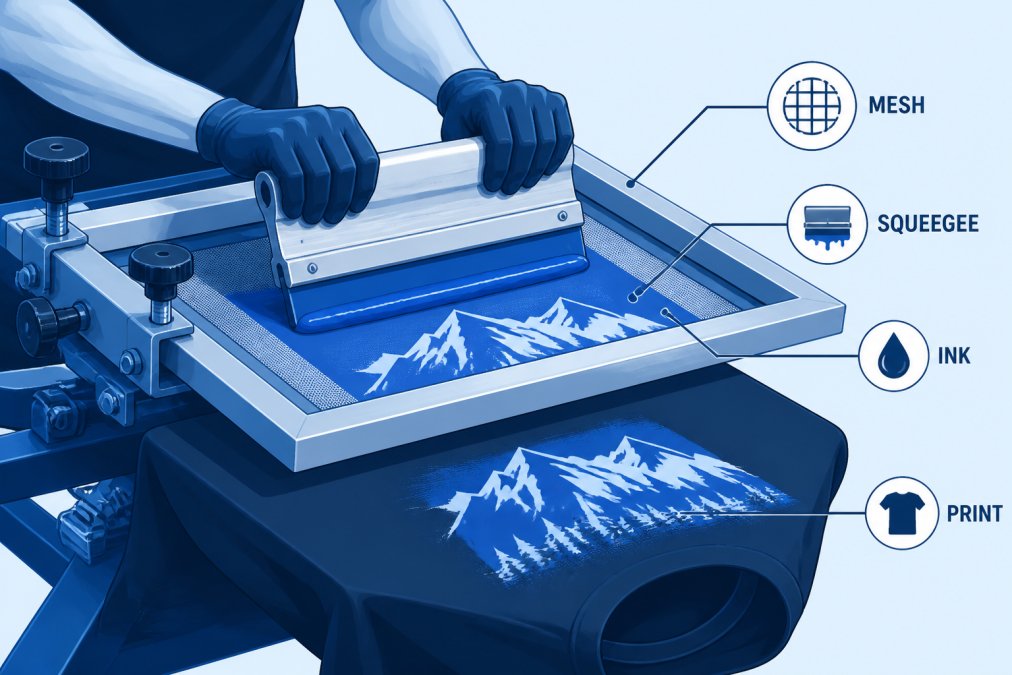
Screen printing applies ink through a mesh stencil, one color at a time. It produces exceptionally vibrant, durable prints with excellent wash durability. The ink bonds into the fabric rather than sitting on top. Screen printing is best for bulk orders with limited colors. The setup cost (creating screens for each color) makes it less economical for small runs or designs with many colors.
DTF (direct-to-film) transfers a printed film directly onto the garment using a heat press. DTF handles full-color, photographic, and gradient-heavy designs without the per-color cost structure of screen printing. It works on a wider range of substrates, including nylon, polyester, and cotton blends. For orders under 50 units or complex color gradients, DTF is often the more practical choice.
| Method | Best For | Color Limit | Wash Durability | Min. Order |
|---|---|---|---|---|
| Screen Printing | Bulk orders, simple designs | 1-6 colors (cost-effective) | Excellent | Often 24+ |
| DTF | Small runs, complex art | Unlimited | Very Good | 1+ |
| DTG | Photo-realistic prints, cotton | Unlimited | Good (pretreat matters) | 1+ |
| Embroidery | Logos, polos, hats | Limited by thread | Excellent | 1+ |
DTG and Embroidery: When Each Method Wins
DTG (direct-to-garment) prints directly onto fabric using modified inkjet technology. It excels at photographic detail on 100% cotton garments. The limitation: DTG struggles on dark garments without pretreatment, and the ink sits on the fabric surface, making wash care more important for longevity. It’s not well-suited for polyester or synthetic blends.
Embroidery produces a textured, dimensional look that communicates quality and permanence. It’s the standard for professional uniforms, polo shirts, hats, and jackets. Embroidery doesn’t fade, crack, or peel. The constraint is design complexity, fine lines, gradients, and small text don’t translate well to thread. According to Impressions Magazine’s guide to garment decoration methods, embroidery consistently ranks highest for perceived quality among recipients of branded apparel.
How Fabric Composition Affects Print Quality Results
The substrate is as important as the print method.
Cotton is the most receptive fabric for ink-based printing. It absorbs ink well, produces vibrant color saturation, and works with every major print method. 100% cotton is the standard recommendation for DTG and screen printing.
Polyester repels water-based inks, which is why DTG doesn’t work well on it. However, polyester accepts sublimation printing exceptionally well, with the ink bonding at a molecular level. DTF transfers also adhere well to polyester. For athletic and performance wear, polyester blends paired with the right method are often the right choice.
Cotton-poly blends (typically 50/50 or 60/40) offer a middle ground. They’re softer than 100% polyester and more dimensionally stable than 100% cotton. Screen printing and DTF both work well on blends.
Garment weight also matters. Heavier garments (5.5 oz. minimum) tend to hold their shape better during printing and resist distortion.
Watch Out
Ordering polyester-heavy garments for DTG printing is one of the most common and expensive mistakes in [custom merch](/2026/08/06/affordable-custom-hoodies-for-small-teams/). The ink won’t absorb properly, resulting in washed-out, inconsistent color. Always confirm fabric composition before selecting your print method.
Ordering polyester-heavy garments for DTG printing is one of the most common and expensive mistakes in [custom merch](/2026/08/06/affordable-custom-hoodies-for-small-teams/). The ink won’t absorb properly, resulting in washed-out, inconsistent color. Always confirm fabric composition before selecting your print method.
How to Start a Merch Business: Production and Fulfillment Setup
The core choice is between managing your own inventory or using a print-on-demand model.
Inventory-based production means ordering in bulk, holding stock, and shipping orders yourself or through a 3PL. Bulk orders lower per-unit cost significantly and give faster ship times. The risk is capital tied up in unsold inventory.
Print-on-demand means products are printed and shipped individually as orders come in. There’s no minimum order quantity and no inventory risk. The tradeoff is higher per-unit cost and longer production lead times. For new brands testing designs, print-on-demand is a sensible starting point.
Sample Testing Before You Scale
Before committing to a production run of 200 shirts, order a sample. A sample lets you evaluate color accuracy, print placement, fabric hand-feel, and sizing. It also catches issues before they affect your entire run.
Most reputable decorators offer sample production. For any order over 50 units, sample testing is essential.
Pro Tip
When evaluating a sample, wash it three times before judging print quality. Most print failures show up in the first few washes, not on day one. A print that survives three wash cycles with color and adhesion intact is a reliable indicator of production quality.
When evaluating a sample, wash it three times before judging print quality. Most print failures show up in the first few washes, not on day one. A print that survives three wash cycles with color and adhesion intact is a reliable indicator of production quality.
Post-Print Care Instructions That Protect Print Fidelity
How garments are cared for after printing determines how long they hold up. Including care instructions with your merch protects the investment your customers made.
For screen-printed and DTG garments, the standard recommendations are:
- Wash inside out in cold water
- Avoid bleach and fabric softeners
- Tumble dry on low or hang dry
- Do not iron directly on the print
DTF transfers are generally more heat-resistant than DTG. Embroidered items are the most durable and require the least special handling. According to the American Apparel & Footwear Association’s care labeling guidelines, proper care labeling is also a federal requirement for garments sold in the United States under FTC regulations.
Best Print on Demand Companies: What to Look For
Choosing a print-on-demand or custom decoration partner is one of the highest-impact decisions in your merch workflow.
The best print on demand companies share these characteristics:
- Transparent file requirements: They specify DPI, color mode, file format, and bleed requirements upfront.
- Sample availability: Any serious decorator will let you order a sample before a full run.
- Multiple print methods: A partner who only offers one method will push every project through that method, whether it’s the right fit or not.
- Color matching capabilities: Ask about Pantone matching for screen printing and CMYK conversion for digital methods.
- Production lead times: Get specific timelines in writing.
- Client-provided garment acceptance: Confirm they’ll work with client-supplied garments if you have specific fabric requirements.
Action Designs handles all four major decoration methods, screen printing, embroidery, DTG, and DTF, and works with both supplied garments and client-provided items.
How to Print High Quality Merch: A Step-by-Step Checklist
Phase 1: Design Preparation
- Confirm file format: vector for logos and text; high-res raster at 300 DPI for photographic art
- Set color mode to CMYK; note Pantone codes for brand colors
- Size artwork to actual print dimensions
- Add bleed if required (typically 0.125 inches)
- Remove any RGB-only colors
Phase 2: Method and Substrate Selection
- Confirm fabric composition and weight
- Match print method to fabric and design complexity
- Verify minimum order quantity and per-unit pricing
- Confirm production lead time and shipping timeline
Phase 3: Sample and Approval
- Order a sample before committing to full production
- Wash the sample 3 times and evaluate print integrity
- Check color accuracy against original file
- Confirm print placement and sizing
Phase 4: Production and Fulfillment
- Submit final approved files with written color references
- Confirm proof approval process before production
- Plan fulfillment method: in-house, 3PL, or print-on-demand
- Include care instructions with finished garments
Phase 5: Post-Delivery Review
- Inspect a cross-section of units from the production run
- Document any quality deviations for future reference
- Collect feedback from recipients after first wash cycle
| Phase | Key Action | Common Mistake to Avoid |
|---|---|---|
| Design Prep | Submit vector or 300 DPI raster | Using web-resolution files |
| Method Selection | Match method to fabric type | DTG on polyester garments |
| Sample Testing | Wash 3x before approving | Judging quality on day one only |
| Production | Get written proof approval | Assuming verbal specs are locked |
| Post-Delivery | Inspect cross-section of run | Only checking top of the box |
For sustainability-conscious brands, the print method and ink type affect environmental impact. Water-based inks used in screen printing and DTG are generally lower in VOC emissions. Some decorators offer certified eco-friendly ink options. The EPA’s Safer Choice program for chemical products provides a framework for evaluating the environmental profile of inks used in garment decoration.
Producing merch that holds up in print quality, color accuracy, and wash durability requires getting the details right at every stage. From file preparation through fabric selection to fulfillment, each decision compounds. Action Designs specializes in all four major decoration methods, works with client-supplied garments, and scales from single-unit samples to full production runs. Get a quote from Action Designs and put this process to work.
Frequently Asked Questions
What is the best printing method for merch?
The best method depends on your order size, design complexity, and fabric type. Screen printing delivers the most durable, vibrant results for large batches with simple artwork. DTF (Direct to Film) handles full-color, intricate designs on small runs without minimum order quantity restrictions. DTG suits photo-realistic prints on 100% cotton. Embroidery works best for logos on hats, polos, and structured garments where a premium, textured finish matters. Matching the method to the substrate and design is what separates professional merch from disappointing results.
Is DTF better than screen printing for small batches?
For small batches, DTF is generally the more cost-effective choice. Screen printing requires creating separate screens per color, which adds setup costs that only become economical at higher quantities. DTF transfers full-color artwork directly onto film and heat-presses it onto the garment, with no screen setup fees. This makes DTF ideal for runs under 24 pieces or designs with many colors. For orders of 48 or more with simpler artwork, screen printing typically delivers lower per-unit costs and stronger wash durability.
What file formats are required for high-quality merch printing?
Vector files in AI, EPS, or PDF format are the standard for screen printing and embroidery because they scale to any size without losing detail. For DTG and DTF printing, high-resolution raster files in PNG or TIFF format work well, provided they are at least 300 DPI at the final print size. Always submit files in CMYK color profile for print accuracy. Transparent backgrounds on PNG files eliminate unwanted halos around designs. Sending the wrong file type is one of the most common reasons print quality falls short of expectations.
How do I ensure my merch designs look professional after washing?
Wash durability starts with the right print method for the fabric, but post-print care makes a significant difference. Turn garments inside out before washing, use cold water on a gentle cycle, and avoid high-heat dryers. Bleach and fabric softeners degrade ink bonds faster. For screen-printed and DTF items, avoid ironing directly over the design. Communicating these care instructions to your customers protects print fidelity over time. Ordering a sample and running it through five to ten wash cycles before placing a full production run is the most reliable quality check available.
How do I choose the right fabric for custom apparel printing?
Fabric composition directly affects ink absorption and print clarity. 100% cotton provides the best ink absorption for DTG and screen printing, producing sharp, vibrant results. Polyester and performance blends work well with DTF and sublimation but can cause color shifting with water-based inks. Tri-blend fabrics (cotton, polyester, rayon) offer a soft hand feel but may produce a slightly vintage or faded print appearance due to the synthetic content. Heavier garment weight, typically 5.5 to 6.1 ounces per square yard, holds up better through repeated washes and gives merch a retail-quality feel.
How do I start a merch business with professional-grade printing?
Start by defining your target audience and the products they actually want, then choose a print method that fits your typical order sizes and design style. Prepare production-ready artwork in the correct file formats before approaching any printer. Order samples of every product before selling, and run wash tests to confirm durability. Set up a simple online storefront to handle orders, then decide whether to hold inventory or use a print-on-demand fulfillment model. Working with a single experienced print partner from the start reduces revision time and keeps branding consistent across your entire product line.
This article was written using GrandRanker