Custom hats, shirts, and more – Order online today!

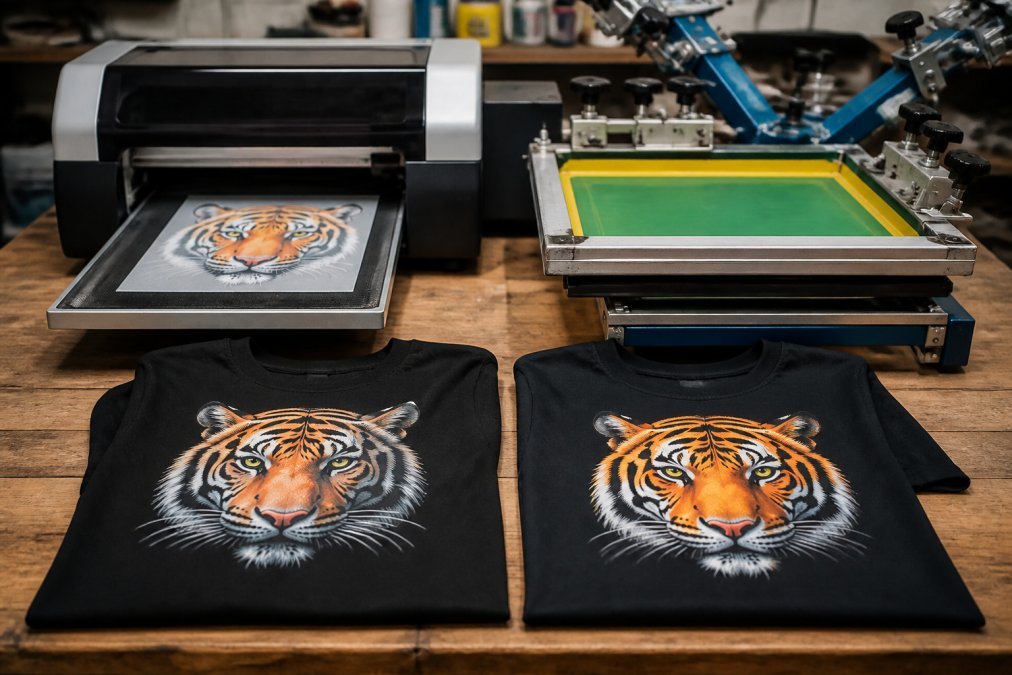
DTF vs Screen Printing for Logos: 2026 Guide
DTF vs screen printing for logos: compare cost per shirt, durability, order minimums, and design detail to find the right method. Get a quote today.
Table of Contents
- DTF vs Screen Printing for Logos: The Core Differences
- Print Quality, Color Vibrancy, and Design Complexity
- DTF Printing Cost Per Shirt: What Actually Drives the Price
- Screen Printing Minimum Order Quantities and Setup Costs
- Durability of DTF Transfers vs Screen Print After Washing
- Fabric Compatibility and Breathability
- Choosing Between DTF vs Screen Printing for Your Logo
- Conclusion
Last Updated: August 7, 2026
DTF vs Screen Printing for Logos: The Core Differences
Choosing the wrong printing method for your logo can mean cracked transfers after a dozen washes, blown budgets on setup fees, or artwork that loses all its fine detail in production. At Action Designs, we work with orders ranging from 50 branded polos to campaigns of thousands of pieces, and the DTF vs screen printing decision comes up on nearly every order.
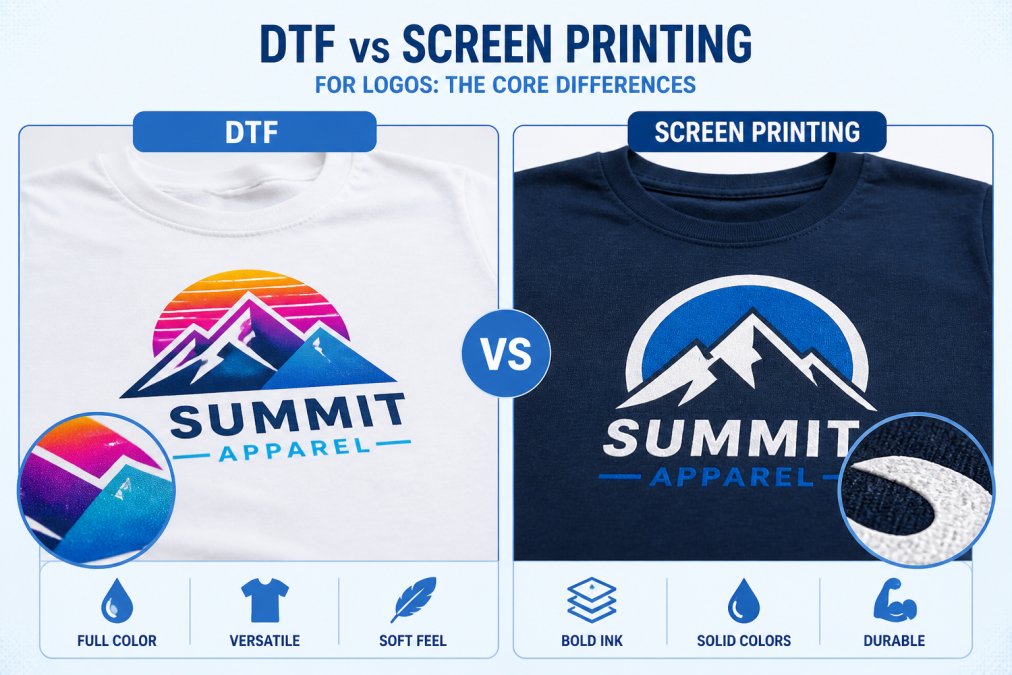
DTF printing excels at small runs, photographic detail, and full-color logos with gradients. Screen printing wins on large volumes, durability on cotton, and cost-per-unit at scale. The right choice depends on your logo complexity, order size, and how long you need the print to last.
How Direct to Film Printing Works
Direct to film printing is a heat transfer process where a design is printed onto specialized PET film using water-based inks, coated with hot-melt adhesive powder, cured in an oven, and then heat-pressed onto the garment. The result is a full-color graphic that bonds directly to fabric fibers.
DTF requires no screen burning or color separation. A 7-color logo costs the same to set up as a 2-color logo. DTF transfers work on virtually any fabric, cotton, polyester, poly-blends, nylon, and canvas, without garment pre-treatment.
How Screen Printing Works
Screen printing forces plastisol ink through a mesh screen that has been coated with light-sensitive emulsion and exposed to UV light to burn the design into the screen. Each color requires its own separate screen, emulsion process, and press pass.
Once screens are made, economics shift dramatically in favor of volume. A print shop running 500 shirts achieves very low cost-per-print because setup costs spread across the run. Plastisol inks deliver exceptional opacity, color vibrancy on cotton, and wash durability that holds up over years of regular laundering. The trade-off is setup time and cost for every new color, design, and order size.
Print Quality, Color Vibrancy, and Design Complexity
DTF wins on design complexity. Full-color graphics, photographic images, fine gradients, and intricate detail translate directly from your digital file to the garment without color separation or spot color limitations. Drop shadows, subtle gradients, and overlapping transparent layers all print in a single pass.
Screen printing produces exceptional results for spot color designs: bold, flat areas of color with clean edges and outstanding opacity. A two-color logo on a dark garment printed with high-quality plastisol ink will look sharper and feel more substantial than most DTF transfers. Screen printing struggles with photographic quality and gradient printing, which require halftone dot patterns that can look coarse at smaller sizes.
Key Takeaway
For logos with gradients, fine detail, or more than four colors, DTF consistently produces cleaner results at lower setup cost. For bold, two- to four-color logos on large runs, screen printing delivers superior vibrancy and a better hand-feel.
For logos with gradients, fine detail, or more than four colors, DTF consistently produces cleaner results at lower setup cost. For bold, two- to four-color logos on large runs, screen printing delivers superior vibrancy and a better hand-feel.
Logo File Requirements for Each Method
For DTF printing:
- Raster images should be at least 300 DPI at the intended print size.
- PNG files with transparent backgrounds are preferred. JPEG files introduce compression artifacts visible in fine detail.
- Colors are printed as-is from your digital file. RGB files translate well; CMYK files may shift slightly.
- Gradients, drop shadows, and transparency layers all print accurately.
For screen printing:
- Vector artwork in AI or EPS format is strongly preferred. Vector files scale to any size without losing sharpness.
- Each color must be on a separate layer or be clearly separable. Gradients require special halftone handling.
- Color matching uses Pantone references. Provide specific PMS colors explicitly for consistency.
- Minimum recommended resolution for raster elements: 600 DPI at print size, though vector is always better.
Watch Out
Submitting a low-resolution JPEG for screen printing is one of the most common causes of blurry or pixelated results. If your logo file is only available as a small PNG from your website, request a vector file from your designer before placing your order.
Submitting a low-resolution JPEG for screen printing is one of the most common causes of blurry or pixelated results. If your logo file is only available as a small PNG from your website, request a vector file from your designer before placing your order.
DTF Printing Cost Per Shirt: What Actually Drives the Price
DTF printing cost per shirt is driven by print size, number of locations being printed, and total quantity ordered. Unlike screen printing, DTF has no per-color setup cost, making it economically attractive for small runs of complex designs. For orders under 50 shirts, DTF is almost always more cost-effective than screen printing.
What scales DTF costs upward is print area. A large back print uses significantly more film, ink, and adhesive powder than a small chest logo. DTF pricing typically drops on a per-unit basis as order volume increases, but less dramatically than screen printing because there are no large fixed setup costs to amortize. For orders above 200 pieces with a simple logo, screen printing often becomes more cost-effective per unit.
For current pricing on DTF transfers and custom apparel, contact Action Designs directly for a quote based on your specific design and quantity.
| Factor | DTF Impact | Screen Printing Impact |
|---|---|---|
| Number of colors | None | High (per-screen setup cost) |
| Print area/size | High | Moderate |
| Order quantity | Moderate savings at volume | Large savings at volume |
| Design complexity | None | High (color separations) |
| Fabric type | None (works on all) | Moderate (cotton preferred) |
| Turnaround time | Fast (no screen setup) | Slower for new designs |
Pro Tip
If you’re ordering fewer than 50 shirts with a multi-color logo, get a DTF quote first. The absence of screen setup fees almost always makes it the better starting point for short runs.
If you’re ordering fewer than 50 shirts with a multi-color logo, get a DTF quote first. The absence of screen setup fees almost always makes it the better starting point for short runs.
Screen Printing Minimum Order Quantities and Setup Costs
Screen printing minimums exist because of fixed setup costs. Every design requires screens to be made, one per color, and those screens cost time and materials regardless of how many shirts get printed. Most print shops set minimums between 12 and 24 pieces for basic single-color screen printing. Multi-color designs typically carry higher minimums because per-color setup costs multiply quickly. A 6-color logo might require a minimum of 48 to 72 pieces before the math works in the customer’s favor.
Setup fees are charged separately from per-unit print cost. A provider might charge a screen fee per color plus a per-shirt price that drops at quantity breaks. Small orders of complex designs can be surprisingly expensive per shirt, while large orders of simple designs become very affordable.
According to Impressions Magazine’s guide to garment decoration methods, screen printing remains the dominant production method for orders above 72 pieces in the decorated apparel industry, precisely because of this cost-per-unit advantage at scale.
Durability of DTF Transfers vs Screen Print After Washing
Well-applied DTF transfers, cured at the correct temperature and pressure, hold up well through regular washing. The adhesive powder bonds the transfer to fabric fibers, and a properly cured transfer will not peel or crack under normal laundering. Failure typically results from improper curing: too low a temperature, insufficient dwell time, or a cold-peel film pulled before fully cooling.
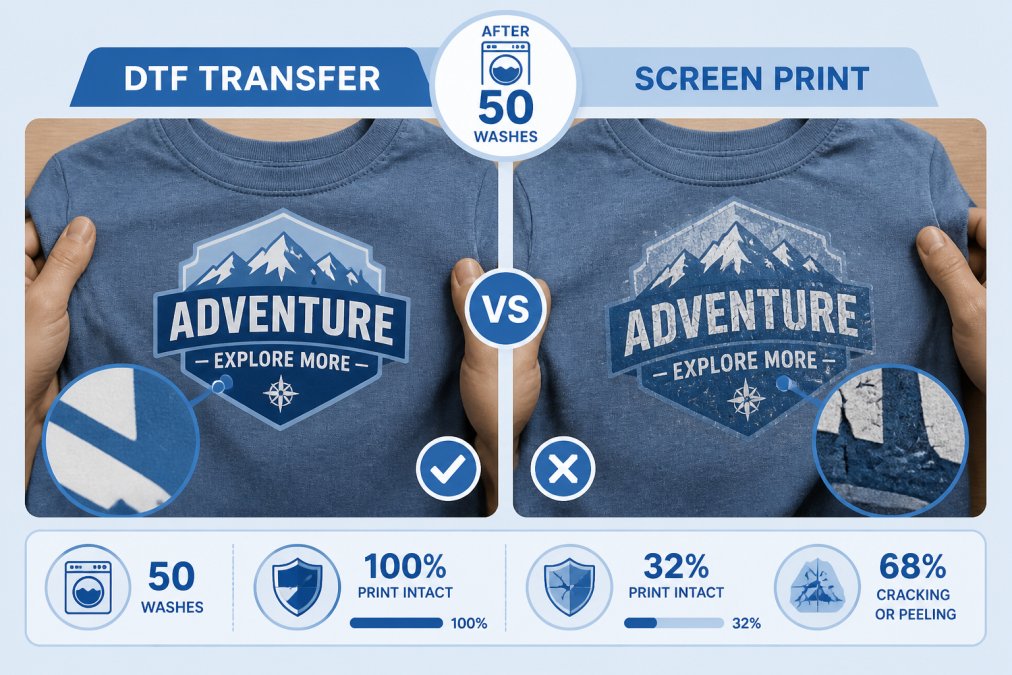
Screen printing with plastisol inks is extremely durable when done correctly. Plastisol cures into a solid layer on top of the fibers, resistant to fading and cracking over many wash cycles. Proper curing in a conveyor oven is critical: under-cured plastisol will wash out prematurely, while properly cured prints maintain vibrancy for years.
Long-Term Aging, Cracking, and Garment Longevity
Screen-printed plastisol ink maintains garment longevity. A properly cured screen print on quality cotton can outlast the shirt itself, maintaining color vibrancy through hundreds of wash cycles. The main long-term failure mode is cracking in the ink layer, typically on older prints stretched repeatedly or washed at high temperatures.
DTF transfers age well under normal conditions but are more sensitive to high heat in the dryer. Repeated high-heat drying cycles can cause delamination or cracking, particularly at design edges. Washing garments inside-out in cold water and tumble drying on low heat significantly extends DTF transfer lifespan. For garments with heavy daily use, such as workwear or team uniforms washed frequently, screen printing on cotton offers a durability advantage.
Fabric Compatibility and Breathability
Screen printing is most effective on cotton and high-cotton-content blends. Plastisol ink bonds best to natural fibers. Printing on 100% polyester with plastisol requires specialty inks to prevent dye migration, where fabric dye bleeds into the ink layer and discolors the print.
DTF transfers work on cotton, polyester, poly-blends, nylon, canvas, and most other fabrics without modification. This is a genuine advantage for orders involving performance wear, athletic uniforms, or mixed-fabric garments. There is no dye migration concern with DTF because the transfer film creates a barrier between ink and fabric dye.
Both methods add a layer to the garment surface, slightly reducing breathability in the print area. DTF transfers tend to have a slightly more noticeable hand-feel than a well-applied screen print using soft-hand plastisol formulation. For chest logos and smaller graphics, most wearers notice no difference.
Choosing Between DTF vs Screen Printing for Your Logo
Choose DTF when:
- Your order is under 72 pieces
- Your logo has more than four colors, gradients, or fine photographic detail
- You need to print on polyester, blends, or mixed-fabric garments
- You need fast turnaround with no screen setup time
- You want print-on-demand flexibility with no minimum order quantity
Choose screen printing when:
- Your order is 72 pieces or more
- Your logo is two to four spot colors with clean, bold shapes
- You’re printing on 100% cotton or high-cotton-content garments
- Long-term durability through heavy washing is the priority
- You want the lowest possible cost-per-print at high volume
A school ordering 300 cotton t-shirts for a fundraiser with a two-color mascot logo should screen print. A brand ordering 30 hoodies with a full-color gradient logo should use DTF. A corporate event coordinator ordering 150 poly-blend polo shirts should strongly consider DTF to avoid dye migration issues.
When to Combine Both Methods
Many professional garment decorators, including the team at Action Designs, use both methods on the same order when the design calls for it. A common approach is screen printing a large, bold back graphic in two spot colors for maximum vibrancy and durability, then using a DTF transfer for a small, multi-color chest logo with fine detail that would require too many screens to be cost-effective.
| Scenario | Recommended Method | Reason |
|---|---|---|
| 30 hoodies, full-color gradient logo | DTF | No setup cost, handles gradients |
| 300 cotton tees, 2-color logo | Screen printing | Low cost-per-unit at volume |
| 50 poly-blend polos, 5-color logo | DTF | Dye migration risk on polyester |
| 500 event shirts, 1-color design | Screen printing | Lowest per-unit cost |
| 20 mixed garments, detailed artwork | DTF | No minimum, no color limits |
| 200 uniforms, bold chest + back logo | Combination | Best economics and quality per location |
For the most accurate pricing on your specific logo, quantity, and garment type, reach out to Action Designs for a custom quote. The team works with orders from a single shirt to full collections, with no minimum too small to discuss.
Choosing between DTF and screen printing is less about which method is better and more about which is right for your specific logo, fabric, and volume. Many buyers get this decision wrong by defaulting to one method without running the numbers on the other. Action Designs offers both screen printing and DTF, along with embroidery and DTG, so the recommendation you get is based on what actually works for your order, not on what equipment happens to be available. Get a quote and let the specs drive the decision.
Frequently Asked Questions
Is DTF better than screen printing for small logo runs?
DTF is generally the better choice for small runs, typically under 24 pieces. Because there are no screens to burn and no color separation setup fees, the cost per shirt stays reasonable even for a single garment. Screen printing's setup costs make it expensive at low quantities, but those same fixed costs spread across large orders, making screen printing more cost-effective once you're ordering 48 or more pieces with a simple logo design.
What are the main disadvantages of DTF printing for apparel?
DTF transfers sit on top of the fabric rather than bonding into the fibers, which can reduce breathability slightly on the printed area. The hand-feel is more noticeable than a well-executed screen print, especially on soft fabrics. DTF transfers can also crack or peel over time if washing instructions aren't followed, particularly with high heat. For logos requiring a truly soft, barely-there feel, water-based screen printing or discharge printing may be preferable.
Does DTF or screen printing offer better wash durability for logos?
Plastisol screen printing on cotton garments is widely regarded as the most durable option for logos, with prints that can last the life of the garment when properly cured. DTF transfers are durable but more sensitive to washing temperature and drying heat. Both methods hold up well under normal care. Cracking and peeling in either method usually trace back to improper curing during production or ignoring care labels, not an inherent flaw in the technology itself.
Is DTF technology replacing traditional screen printing?
DTF has taken significant market share in the print-on-demand and short-run custom apparel segment, but screen printing remains dominant for high-volume orders and branded merchandise programs. The two methods serve different needs rather than one replacing the other. Many custom apparel providers, including Action Designs, offer both, allowing clients to choose based on order size, design complexity, and budget rather than being locked into a single production method.
How does the cost per logo compare between DTF and screen printing at 200 shirts?
At 200 shirts, screen printing typically becomes more cost-effective per unit than DTF, especially for logos with fewer than five spot colors. The setup cost for burning screens is absorbed across the run, driving the per-shirt price down. DTF cost per shirt stays more consistent regardless of quantity, so it doesn't drop as sharply at scale. For a 200-piece order with a 7-color logo, however, DTF can still be competitive because each additional color adds a new screen in screen printing. Contact Action Designs for a quote specific to your order.
This article was written using GrandRanker